The Age of Too Much: Decision Fatigue in a World of Infinite Choice
It shows up at 9pm, when someone asks what you want to watch — and your brain, after hundreds of decisions, just can’t.
You’ve made it to the end of the day.
The kids are fed. The emails are answered. The to-do list has been partially conquered. You finally sit down, remote in hand, and your partner says:
“What do you want to watch?”
And something in you just… stops.
Not because you’re tired of TV. Not because the options are bad. But because your brain has already made hundreds of decisions today — and this one, small and silly as it seems, is the one that tips everything over.
You scroll. You back out. You say “I don’t care” — even though you do.
That’s not laziness. That’s not indifference.
That’s decision fatigue. And for women who are managing work, family, and the invisible load of running a household, it’s one of the most exhausting things nobody talks about.
The decisions you don’t even count
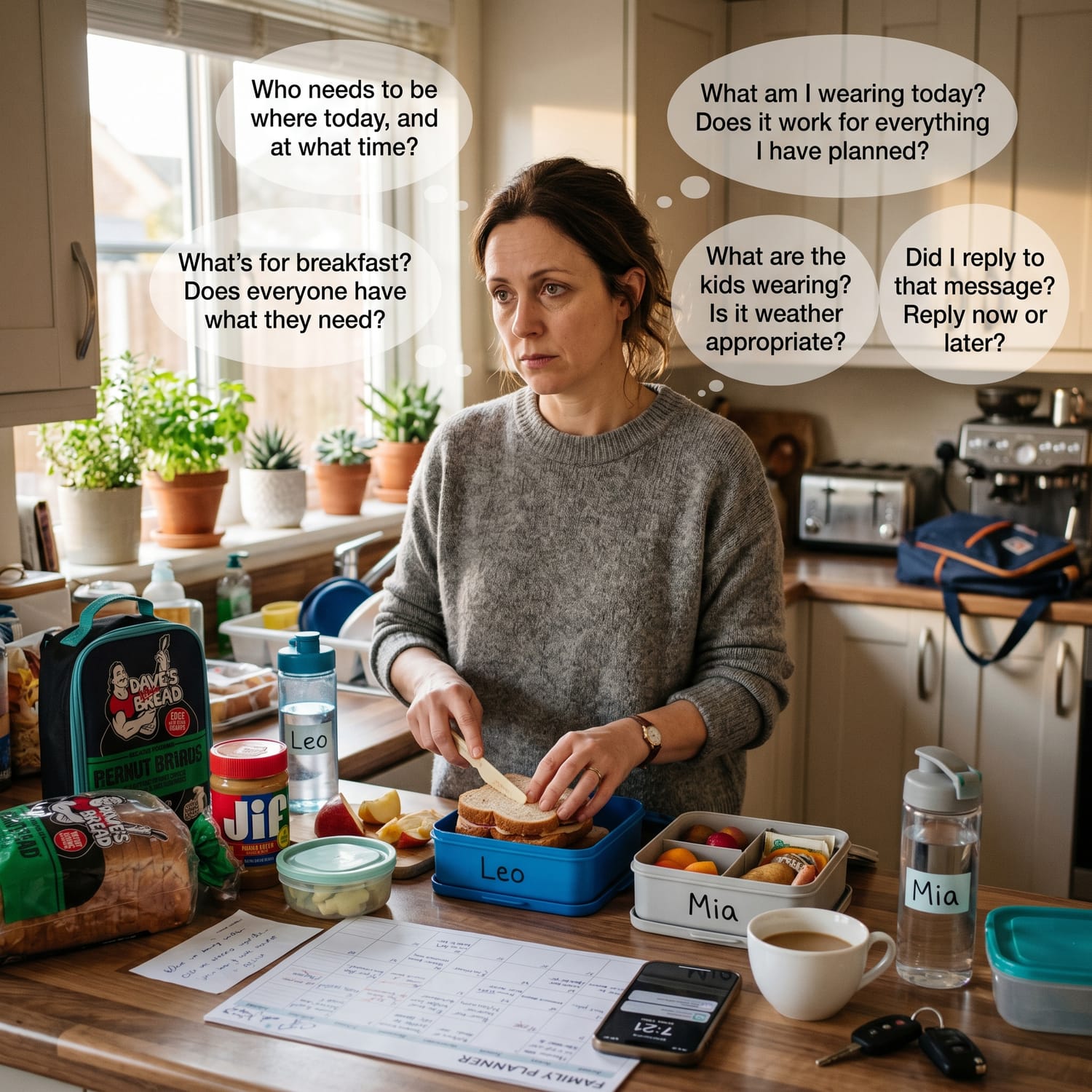
Here’s what a typical morning might look like before you’ve even left the house:
• What should I have for breakfast? Do I even want breakfast today?
• Should I straighten my hair, curl it, or clip it up?
• Who needs to be where today, and at what time?
• What’s for supper? Do we have the ingredients?
• Which way should I take to work, school or shopping?
None of these feel big on their own. That’s what makes it so deceptive.
The weight isn’t in any single decision. It’s in the relentless, unending accumulation of all of them — day after day — with very little recovery space in between.
By evening, you’re not choosing what to watch. You’re just reaching the end of a very long runway.
What is decision fatigue, exactly?
As a nurse for over 20 years, I spent my shifts making constant, high-stakes decisions — medication doses, patient care plans, family communications, emergency responses. But decision fatigue isn’t just a clinical concept. I watched it show up in my colleagues. I felt it myself. And I eventually recognized it bleeding into every corner of my home life too.
The science behind it is straightforward: the human brain has a finite capacity for making quality decisions in a day. The more decisions you make, the more that capacity depletes. And when you hit your limit, your brain doesn’t just get slower — it starts taking shortcuts. You avoid deciding altogether. You make impulsive choices just to be done. You snap at people you love over something small.
Research has shown this in everyone from judges to shoppers to executives. But in my experience? It hits women hardest — because we’re often carrying the most decisions.
What actually helped me
I want to be honest with you: there’s no single fix for this. Life doesn’t get less full. The decisions don’t go away. But I did find that making a few small, intentional changes meant I stopped hitting my limit so early in the day.
That shift — buying back even a couple of hours of mental capacity — made everything feel more manageable.
1. I stopped being the only person deciding dinner
This was the biggest one.
I didn’t realize how much mental energy I was spending just deciding what everyone would eat — every single day. It wasn’t the cooking that drained me. It was starting from zero, every evening, with no plan.
So I changed the system. I asked my husband and my kids to each give me two supper ideas for the month. Just two. Meals they actually wanted to eat.
Then I built the rest of the month around those suggestions. I had a plan. I could shop around it. And something unexpected happened — it didn’t just reduce decision fatigue. It saved money too. Less wandering grocery store aisles. Less food waste. Less “we have nothing” at 5pm.
But the biggest shift was mental. Dinner stopped being a daily drain.
2. I curated what I chose from
Instead of scrolling through thousands of options on streaming platforms every night, I started saving things that caught my eye throughout the day into a simple watch list.
At night, I wasn’t choosing from an ocean of content anymore. I was choosing from a small, pre-approved list I had put together when I had more capacity.
It’s still a decision. But it’s not an overwhelming one. And that alone changed how quickly I could actually relax.
The same principle applies to meal planning, outfits, grocery lists — anything you can pre-decide when you have more mental space, so that future-you doesn’t have to.
3. I stopped relying on coffee alone in the morning
This one might surprise you, but stay with me.
I noticed a pattern: on days when my energy spiked and then crashed mid-morning, decision fatigue hit faster and harder. My brain felt noisier. Everything felt heavier.
I wasn't willing to give up coffee — that was never going to happen. But I started paying attention to how much I was asking one cup to do, and how it was affecting my mental clarity by mid-morning.
So instead of leaning on coffee alone, I added a supplement called Focus — one designed to support steady mental clarity and calm, even energy, without the spike-and-crash cycle.
I noticed the difference within a few weeks. My thinking felt cleaner, especially in the mornings when I have the most decisions ahead of me. I mentioned it to a few friends and coworkers who were dealing with the same kind of daily mental exhaustion.
They felt it too.
That's actually how I ended up becoming an affiliate for it — I was already recommending it to people I cared about, so it made sense to be able to share it more widely. (I'll include the link below if you want to check it out — it's part of my mornings now.)
I want to be clear: it's not a cure. It's support. But on days when my list is long and the decisions are coming fast, it helps me feel a little more steady.
The real shift
None of these changes removed decision fatigue from my life. I still have full days. I still hit my limit sometimes.
But I stopped hitting it at 10am.
And that mattered more than I expected — because when I had more mental capacity in the evenings, I was more patient. More present. More like myself.
The goal was never to have fewer responsibilities. It was to stop spending so much energy on decisions that didn’t need to drain me.
If you feel this, it’s not you
Decision fatigue is real. It’s physiological. And it falls disproportionately on women who are holding the mental load of work, family, and home — often all at once.
You haven’t failed at managing your life. You’ve just been making too many decisions, for too long, without enough recovery space in between.
And most days, it doesn’t show up as a big moment. It shows up at 9pm, when someone asks what you want to watch, and your brain just… can’t.
You deserve better than that.
Small changes — to how you plan, how you delegate, and how you support your own mental clarity — can genuinely move the needle. I know, because they did for me.
If you're curious about Focus, the supplement I mentioned, Click Here. It's not magic — but for me, it's been one of the quietest, most consistent forms of daily support I've found.
Disclaimer
The content on The Cortisol Edit is intended for informational and educational purposes only. Nothing published on this site constitutes medical advice, and no content here should be used as a substitute for the advice, diagnosis, or treatment of a qualified healthcare professional. We do not diagnose, treat, cure, or prevent any health condition or disease.
If you are experiencing symptoms that concern you, please consult your doctor or a licensed healthcare provider before making any changes to your diet, supplement routine, or lifestyle. This is especially important if you are pregnant, breastfeeding, taking prescription medications, or managing an existing health condition.
Some posts on this site contain affiliate links. This means that if you click a link and make a purchase, The Cortisol Edit may earn a small commission — at no additional cost to you. We only reference products we genuinely believe in, and affiliate relationships never influence our editorial content or recommendations.
Individual results from any supplement, dietary change, or wellness practice will vary. What works for one person may not work for another, and nothing on this site should be interpreted as a guarantee of results.
Supplement statements referenced on this site have not been evaluated by the Food and Drug Administration.