Why Your Morning Coffee Is Spiking Your Cortisol — And the Simple Swap That Fixed Mine
Okay, real talk. For a long time, I thought I just had a caffeine tolerance problem.
Wake up already behind. Chug coffee before my feet hit the floor. Feel okay for maybe an hour. Then that hollow, wired-but-tired feeling that shows up around 10AM and turns into a full crash by 2PM.
And instead of stopping to eat actual food or getting outside, I'd just make another coffee. Which gave me the jittery, why-is-my-heart-racing-for-no-reason feeling I'd started to accept as normal.
I thought that was just how coffee worked.
It's not.
What's Actually Happening in Your Body
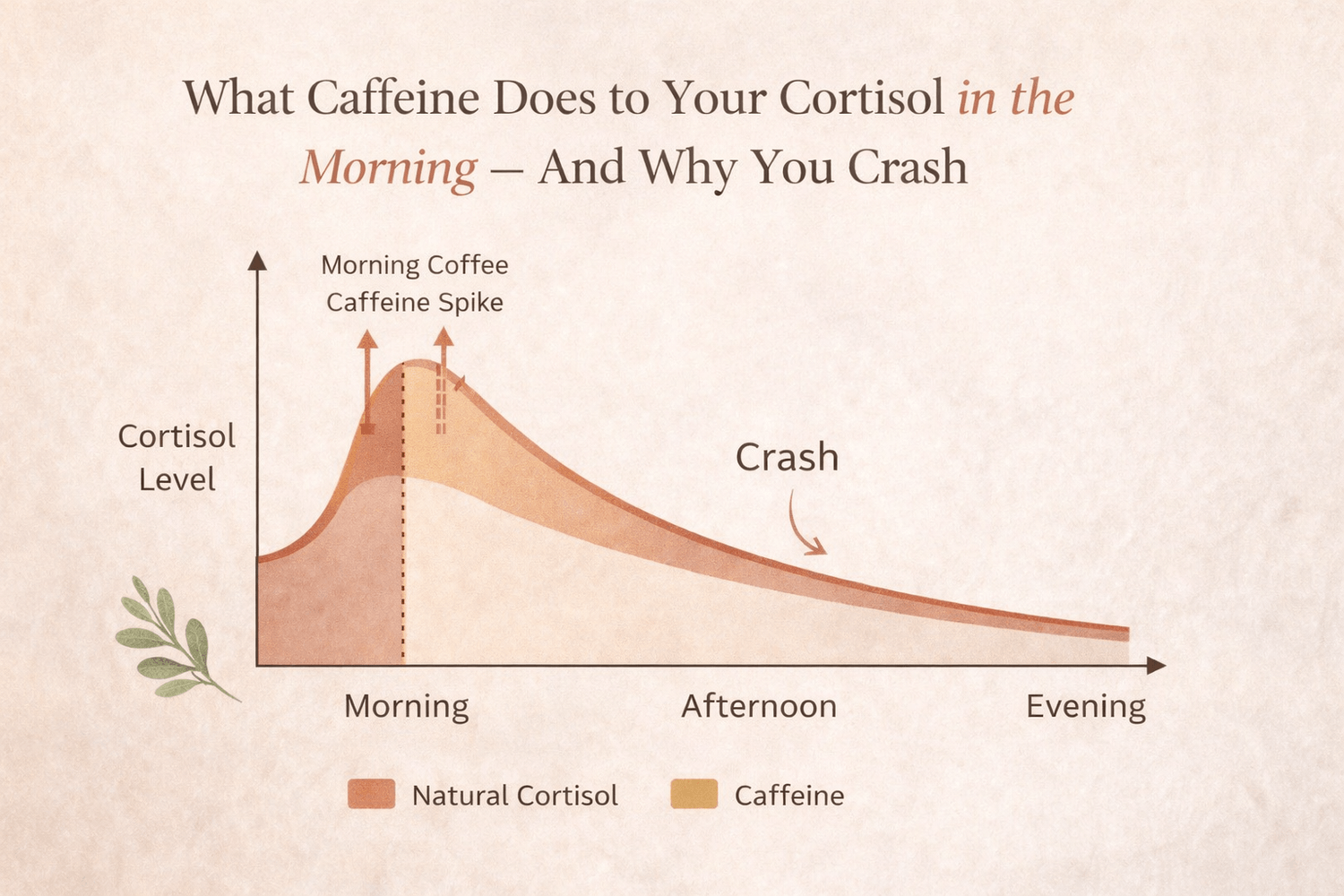
Your body has a built-in wake-up mechanism called the cortisol awakening response. Within 30 to 45 minutes of opening your eyes, cortisol sharply rises. This is a good thing. It's your body mobilizing energy, sharpening your attention, and getting you ready to move through the day.
Coffee, if you drink it during that window, doesn't add to the rise. It hijacks it. Caffeine independently stimulates cortisol release. So instead of one clean natural rise, you're layering an artificial cortisol spike on top of an already-elevated hormone. Your nervous system gets the message that something urgent is happening — even though you're just standing in your kitchen in a robe.
Do that every morning for years while carrying the weight of a full life, and eventually your body stops distinguishing between "the coffee" and "the emergency." Everything becomes an emergency.
That's the wired-but-tired feeling. That's why you crash in the afternoon. That's why your brain feels foggy by early afternoon, why your sleep is patchy, why you're waking up tired no matter how long you were in bed.
It's not the coffee, exactly. It's when you're drinking it, and what your body is being asked to do at the same time.
The Simple Swap
This is where the swap comes in — and it's not what I expected.
For years, I thought fixing my cortisol-and-coffee problem meant switching to a different coffee, or giving up caffeine entirely, or adding another supplement to a routine I couldn't keep. I tried all of that. None of it stuck.
The swap that actually worked was smaller and honestly kind of boring:
Delay the first coffee by 20 minutes. Eat something with protein first. Get some natural light within 30 minutes of waking.
That's the whole swap.
No new products. No lifestyle overhaul. No abandoning the morning ritual I'm attached to. Just a 20-minute delay, some protein, and a few minutes of sunlight or being near a window.
I know that sounds too small to matter. I thought so too. But here's what actually happens biologically when you do it:
Your cortisol awakening response gets to run its natural course. Your blood sugar stabilizes before caffeine hits your system. Your body's internal clock gets the light signal it needs to time the rest of your hormones for the day. And when you do have coffee 20 minutes in, it isn't stacking on top of an artificial peak — it's supporting energy your body has already started to produce on its own.
Same coffee. Same cup. Same ritual. Completely different effect.
What Actually Changed
The first thing I noticed was that the afternoon energy crash softened. Not disappeared. Softened. I was still tired by 2PM, but I could feel it in a normal, "I've been working for six hours" way, not the wall-you-hit-and-can't-climb way.
The second thing was the mornings themselves. I stopped feeling like I was vibrating out of my skin by 9AM. My focus lasted longer. I wasn't reaching for a second and third cup by 11.
The third thing took a couple of weeks, and this one surprised me most: I started actually feeling how tired I was. Which sounds like a bad thing, but it wasn't. Because coffee had been masking my depletion for so long that I couldn't tell when I needed rest until my body forced me to crash. Once I stopped hijacking my morning cortisol response, my body could actually communicate with me. Including when it was time to slow down.
That's the part nobody warns you about. When you stop overriding your nervous system, it starts talking back.
Why This Works When Other Cortisol Advice Doesn't
The reason this swap works is that it doesn't ask you to change what you're doing. It asks you to change when you're doing it. That's a completely different kind of ask.
Most advice on how to lower cortisol in the morning treats you like you have unlimited time, unlimited willpower, and no existing life to work around. Meditate for twenty minutes. Cold plunge. Prep a green smoothie. Journal three pages before touching your phone.
That's why none of it sticks for most women.
This is different. If you're the one who's tried the wellness apps, downloaded the protocols, bought the supplements that didn't stick — the difference is that this is a sequence change to what you're already doing. Not another thing to add.
And it doesn't require you to give up the ritual. The ritual isn't the problem. The ritual is one of the few things that's still yours. The morning coffee is fine. It's the timing that's been quietly wrecking you.
The Bigger Picture
Here's what I want you to know before you close this tab.
Knowing the swap isn't the same as doing it. That's the part I underestimated for a long time. I would read something like this, feel that click of "oh, that makes sense," bookmark the article, and then Monday morning I'd still reach for coffee first thing because my old routine had 20 years of muscle memory behind it. Understanding didn't change my mornings. Structure did.
That's why I put together The 5-Day Morning Reset — a free, printable protocol that walks you through the whole swap, one small shift per day. Five days. Not thirty. Not a full lifestyle overhaul. Just five specific mornings, one habit at a time, with the exact steps and the reason each one matters.
It's built for the woman who's exhausted, wired, and over it — the one who's downloaded the wellness apps and watched the routines collapse by Wednesday. This isn't another morning routine to fail at. It's five days. Print it. Check the boxes. Notice how different your afternoon feels by the end of the week.
Grab your free copy here →The 5-Day Morning Reset
For today: push your first coffee back by 20 minutes tomorrow. Eat something with protein. See what shifts.
Disclaimer
The content on The Cortisol Edit is intended for informational and educational purposes only. Nothing published on this site constitutes medical advice, and no content here should be used as a substitute for the advice, diagnosis, or treatment of a qualified healthcare professional. We do not diagnose, treat, cure, or prevent any health condition or disease.
If you are experiencing symptoms that concern you, please consult your doctor or a licensed healthcare provider before making any changes to your diet, supplement routine, or lifestyle. This is especially important if you are pregnant, breastfeeding, taking prescription medications, or managing an existing health condition.
Some posts on this site contain affiliate links. This means that if you click a link and make a purchase, The Cortisol Edit may earn a small commission — at no additional cost to you. We only reference products we genuinely believe in, and affiliate relationships never influence our editorial content or recommendations.
Individual results from any supplement, dietary change, or wellness practice will vary. What works for one person may not work for another, and nothing on this site should be interpreted as a guarantee of results.
Supplement statements referenced on this site have not been evaluated by the Food and Drug Administration.