What High Cortisol Actually Feels Like — And Why Most Women Miss It
It's 2PM and your brain just quit.
Not dramatically. Not in a way you can explain to anyone. It just got heavy — like someone turned down the dial on your ability to think, focus, or care about the thing you were doing five minutes ago. Your eyes feel gritty. There's a low-grade headache building somewhere behind your temples. You're not hungry exactly, but you're reaching for something — anything — because you need to get through the next three hours and you have no idea how you're going to do it.
You slept last night. You had coffee this morning. You're not sick. You're not depressed. You're just — off. Again. Like you are every single day at this exact time.
And somewhere in the back of your mind, under the frustration and the guilt about not being more productive right now, is a question you've been carrying for a while:
Why does this keep happening to me?
It's not burnout. It's not laziness. It's not your age, your diet, or your willpower.
It's a cortisol pattern — and once you see it, you can't unsee it.
Here's what your body has actually been trying to tell you — and why no amount of rest, coffee, or pushing through is ever going to fix it.
What Cortisol Actually Does (When It's Working the Way It Should)
Cortisol gets a bad reputation, but it's not trying to hurt you. It's a hormone your adrenal glands release in response to stress — and your body genuinely needs it. It wakes you up in the morning. It helps you focus under pressure. It keeps your blood sugar stable and your immune system responsive.
In short bursts, cortisol is what gets things done.
The problem isn't cortisol. The problem is what happens when your body never gets the signal that the threat is over.
Why Your Body Keeps Producing It Even When Nothing Is Wrong
Your nervous system was designed for short-term stress — the kind that ends. A predator shows up, cortisol spikes, you run, the threat passes, your body recovers. The whole cycle takes minutes.
But a demanding job doesn't end. Financial pressure doesn't end. The mental load of managing a home, a career, and everyone else's needs doesn't end. So your body keeps producing cortisol, day after day, because as far as your nervous system is concerned, the threat never left.
This is called chronic cortisol elevation — and it doesn't feel like stress. It feels like your life.
What Happens When High Cortisol Stops Being Temporary
When cortisol stays elevated for months — which for most high-functioning women it does — your body starts making tradeoffs. Functions it considers non-essential get dialed down. Your digestion slows. Your sleep quality drops even when you're getting enough hours. Your mood becomes harder to regulate. Your focus gets patchy.
Your energy follows a pattern that makes no logical sense — wired when you should be sleeping, exhausted when you need to perform.
High cortisol doesn't feel like stress — it feels like a personality. The exhaustion, the irritability, the inability to relax even when you finally have time to — you didn't develop these traits. Your nervous system developed them for you, one cortisol spike at a time.
Your body isn't broken. It's been in survival mode so long it forgot there was another way to operate.
The Smoke Alarm That Never Stopped
Think of it this way. Your cortisol is like a smoke alarm that went off months ago and never stopped.
It went off for a real reason. The smoke was real. But the alarm is still screaming even though the fire is out — and you've been living in that noise for so long you stopped noticing it. You just assumed this is what your house sounds like now.
The problem isn't that you can't handle the noise. The problem is that your body was never designed to live with the alarm going off indefinitely — and everything else in the house is starting to malfunction because of it.
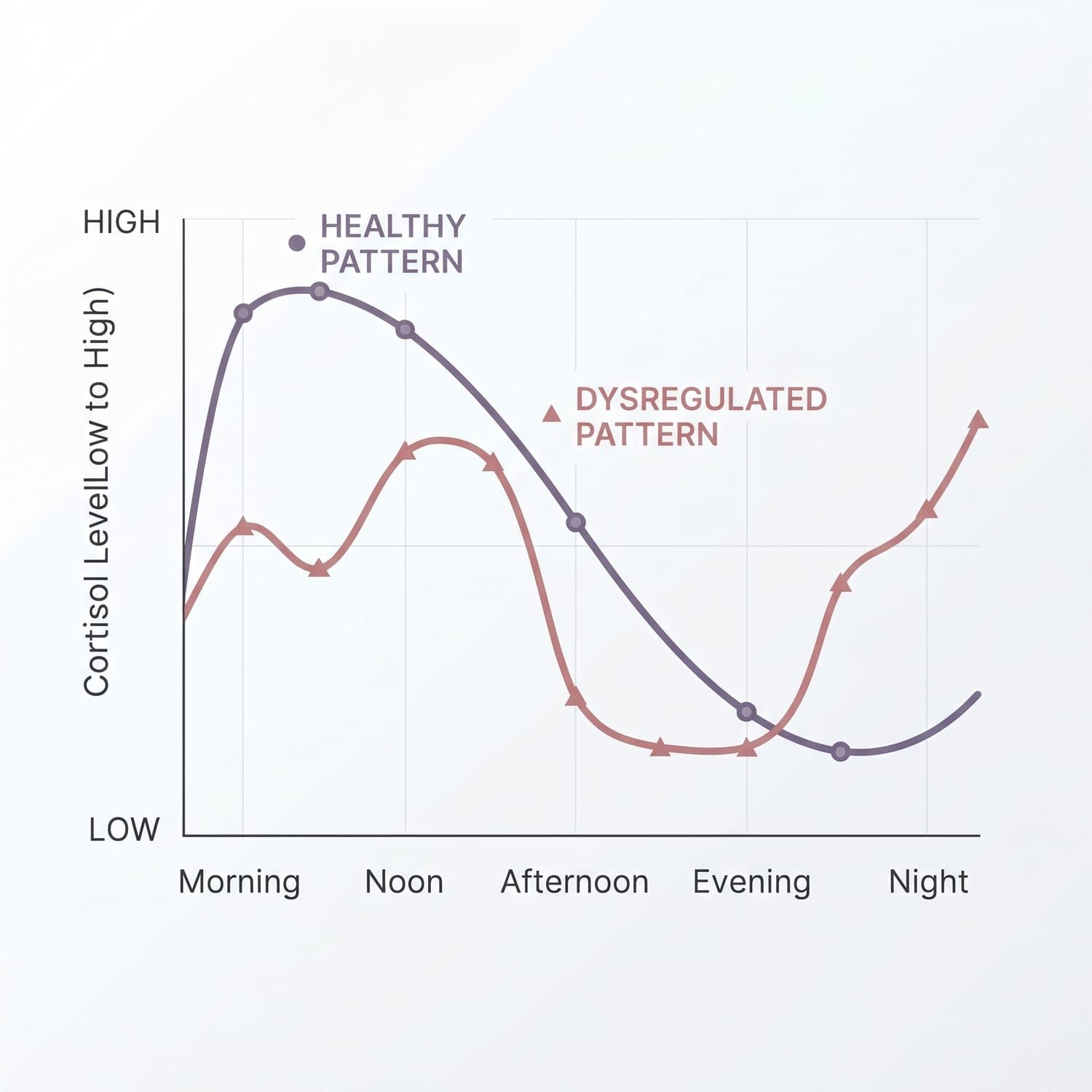
For almost two years, I thought I had a bladder problem and a slow afternoon.
Every day at 3PM my brain just stopped. I figured it was the natural lull in my day — my body wanting a nap because things had quieted down. I ignored it, pushed through it, made another coffee.
Every night somewhere between 3 and 4AM I was awake. Sometimes I had to use the bathroom. Sometimes I just... woke up. And falling back asleep was almost never simple. I'd toss and turn, get up for water, and then realize I was actually hungry — genuinely hungry, like I hadn't eaten dinner. So I'd eat something. In the middle of the night. Which I knew wasn't great, but I didn't know what else to do with the feeling.
If I was lucky I'd fall back asleep around 5AM and be up again by 6. If I wasn't, I'd just start my day at 3AM and spend the afternoon fighting to keep my eyes open.
I told myself this was just getting older. In my twenties I slept like a baby — straight through, every night, no interruptions. I assumed that was just gone now.
It wasn't age. It wasn't my bladder. It was a cortisol pattern I didn't have a name for yet.
The 3AM wake-up, the middle-of-the-night hunger, the afternoon crash, the exhaustion that sleep never fully fixed — those aren't random. They're a recognizable sequence. And once I understood what was actually driving them, everything I'd been experiencing for two years finally made sense.
Robert Sapolsky, a Stanford stress biologist and author of Why Zebras Don't Get Ulcers, has spent decades studying what chronic cortisol elevation does to the human body. His core finding is worth stating plainly: the human stress response was designed for emergencies that end. When it doesn't end — when the source of stress is chronic, invisible, and socially normalized — the same system that keeps you alive in a crisis begins to quietly dismantle your sleep, your metabolism, your mood, and your ability to think clearly.
This isn't a personality flaw. It's biology doing exactly what it was designed to do — in a world it wasn't designed for.
So What Do You Do With This?
This is the part where most articles give you a ten-step protocol. I'm not going to do that — because a protocol isn't what's missing here. Understanding is.
1. Learn your own cortisol pattern before you try to fix anything.
High cortisol doesn't look the same in every woman. Some crash at 2PM. Some can't fall asleep. Some wake at 3AM. Some do all three. Before you reach for a solution, you need to understand which pattern you're running — because the entry point is different depending on where your cortisol cycle is breaking down.
2. Stop trying to rest your way out of it.
Sleep helps. Rest matters. But if your nervous system is stuck in a cortisol loop, rest alone won't reset it — it just slows the drain slightly. This is why you can sleep eight hours and wake up feeling like you didn't sleep at all. Recovery requires more than stillness.
3. Remove what's spiking your cortisol before you add anything new.
Most women go straight to supplements or routines before they've identified what's actively driving their cortisol higher every day. Caffeine timing, blood sugar crashes, decision overload, and chronic under-eating are four of the most common — and the most overlooked.
If you want to go deeper on what's driving it, this article on why your cortisol is so high is a good next read.Why your cortisol is so high
4. Start with understanding, not a protocol.
The women who actually recover from chronic cortisol elevation aren't the ones who found the perfect supplement or morning routine first. They're the ones who understood what their body was doing and why — and built from there. That's not a slow path. That's the only path that actually works.
"I've tried things before and they didn't stick."
That's because most approaches start with habits instead of understanding. A morning routine doesn't work if you don't know which part of your cortisol cycle is broken. A supplement doesn't work if you're still doing three things every day that are actively spiking your cortisol higher. Starting with the pattern first is what makes everything else actually stick.
"Maybe I'm just tired because I'm busy. Everyone is tired."
Yes, everyone is tired. But not everyone wakes up at 3AM hungry. Not everyone crashes at the same time every single day. Not everyone feels more exhausted after a full night of sleep than after a short one. When exhaustion follows a pattern, it's not busyness. It's biology.
"I don't have time for another complicated protocol."
Understanding your cortisol pattern isn't a protocol. It doesn't require a new morning routine, a supplement stack, or an hour of journaling. It requires knowing what your body is doing and why — which is a one-time investment that changes how every other decision lands.
"Is this actually a cortisol problem, or do I need to see a doctor?"
If you're experiencing symptoms that feel severe, new, or sudden — yes, see a doctor. What we're talking about here is the chronic, slow-building pattern that most women have been living with for months or years, that bloodwork often doesn't catch because cortisol fluctuates throughout the day. This isn't a replacement for medical care. It's the layer most medical appointments don't have time to address.
She came in thinking this was a willpower problem. She's leaving knowing it's a cortisol pattern. And patterns can be identified, understood, and interrupted.
If you recognized yourself anywhere in this article, The Cortisol Reset Plan is where I'd suggest starting — not because it's the next thing to try, but because it's the thing that makes everything else finally make sense.
→ Start with The Cortisol Edit - Know Your Pattern

Disclaimer
The content on The Cortisol Edit is intended for informational and educational purposes only. Nothing published on this site constitutes medical advice, and no content here should be used as a substitute for the advice, diagnosis, or treatment of a qualified healthcare professional. We do not diagnose, treat, cure, or prevent any health condition or disease.
If you are experiencing symptoms that concern you, please consult your doctor or a licensed healthcare provider before making any changes to your diet, supplement routine, or lifestyle. This is especially important if you are pregnant, breastfeeding, taking prescription medications, or managing an existing health condition.
Some posts on this site contain affiliate links. This means that if you click a link and make a purchase, The Cortisol Edit may earn a small commission — at no additional cost to you. We only reference products we genuinely believe in, and affiliate relationships never influence our editorial content or recommendations.
Individual results from any supplement, dietary change, or wellness practice will vary. What works for one person may not work for another, and nothing on this site should be interpreted as a guarantee of results.
Supplement statements referenced on this site have not been evaluated by the Food and Drug Administration.